WebMCP Readiness Is a Property of the Site, Not the Widget
A controlled three-site benchmark of agentic readiness. The same AI commerce widget was run against porsync.com and two companies that sell WebMCP and agentic-commerce tooling. The site with declarative WebMCP attributes succeeded; the two without them failed — including the vendor's own homepage.
Porsync Research · Published 2026-05-28
Finding
A compliant AI agent succeeds or fails based on the target site's declarative WebMCP instrumentation, not the agent. porsync.com scored 87/100 (13/15 checks) — the maximum achievable under current browser support — versus 47/100 and 53/100 for two WebMCP-selling vendors.
WebMCP Inspector three-site benchmark (May 2026)
WebMCP Inspector scores and live nekuda agentic-commerce widget outcomes across three sites: porsync.com, nekuda.ai, and webmcpworld.com. Higher Inspector score indicates more complete declarative WebMCP instrumentation.
| Measurement | Value | Note |
|---|---|---|
| porsync.com — Inspector score | 87 / 100 | 13 of 15 checks passed |
| nekuda.ai — Inspector score | 47 / 100 | 7 of 15 checks passed |
| webmcpworld.com — Inspector score | 53 / 100 | 8 of 15 checks passed |
| Widget outcome — porsync.com | Succeeded | Booked a consult, called list_services |
| Widget outcome — webmcpworld.com | Failed | "I cannot fulfill this request." |
| Widget outcome — nekuda.ai | Failed | Navigated to a broken Access Denied page |
Why we ran this
Most sites that claim "AI ready" have optimised for being *cited* — schema markup, llms.txt, clean structured data. That is the AEO layer, and it is necessary. But a second layer is emerging: agentic readiness. Can an AI agent actually *act* on your site — book something, query something, invoke a tool — not just read the page?
We wanted a falsifiable answer to a specific question: when an agentic-commerce widget fails on a website, is that the widget's fault or the website's fault? The industry assumption is that the widget (the agent) is the variable. We designed a test to isolate that.
Method
We held the agent constant and varied the site. The agent was nekuda's live "Ask nekuda" agentic-commerce widget — a shipping commercial product. We ran it, unchanged, against three sites:
| Site | What they sell | WebMCP Inspector score | Checks passed |
|---|---|---|---|
| porsync.com | AI systems portfolio | 87 / 100 | 13 / 15 |
| nekuda.ai | Agentic commerce tooling | 47 / 100 | 7 / 15 |
| webmcpworld.com | WebMCP infrastructure | 53 / 100 | 8 / 15 |
Two of the three sites *sell* WebMCP or agentic-commerce products. porsync.com is the only one of the three not in that business — it is a personal portfolio site that implemented WebMCP as a dogfood.
Result
Same widget. Three sites. One outcome split cleanly along instrumentation lines.
| Site | Widget outcome |
|---|---|
| porsync.com | Booked a consult. Called `list_services` successfully. |
| webmcpworld.com | "I cannot fulfill this request." |
| nekuda.ai (their own site) | Navigated to a broken Access Denied page. |
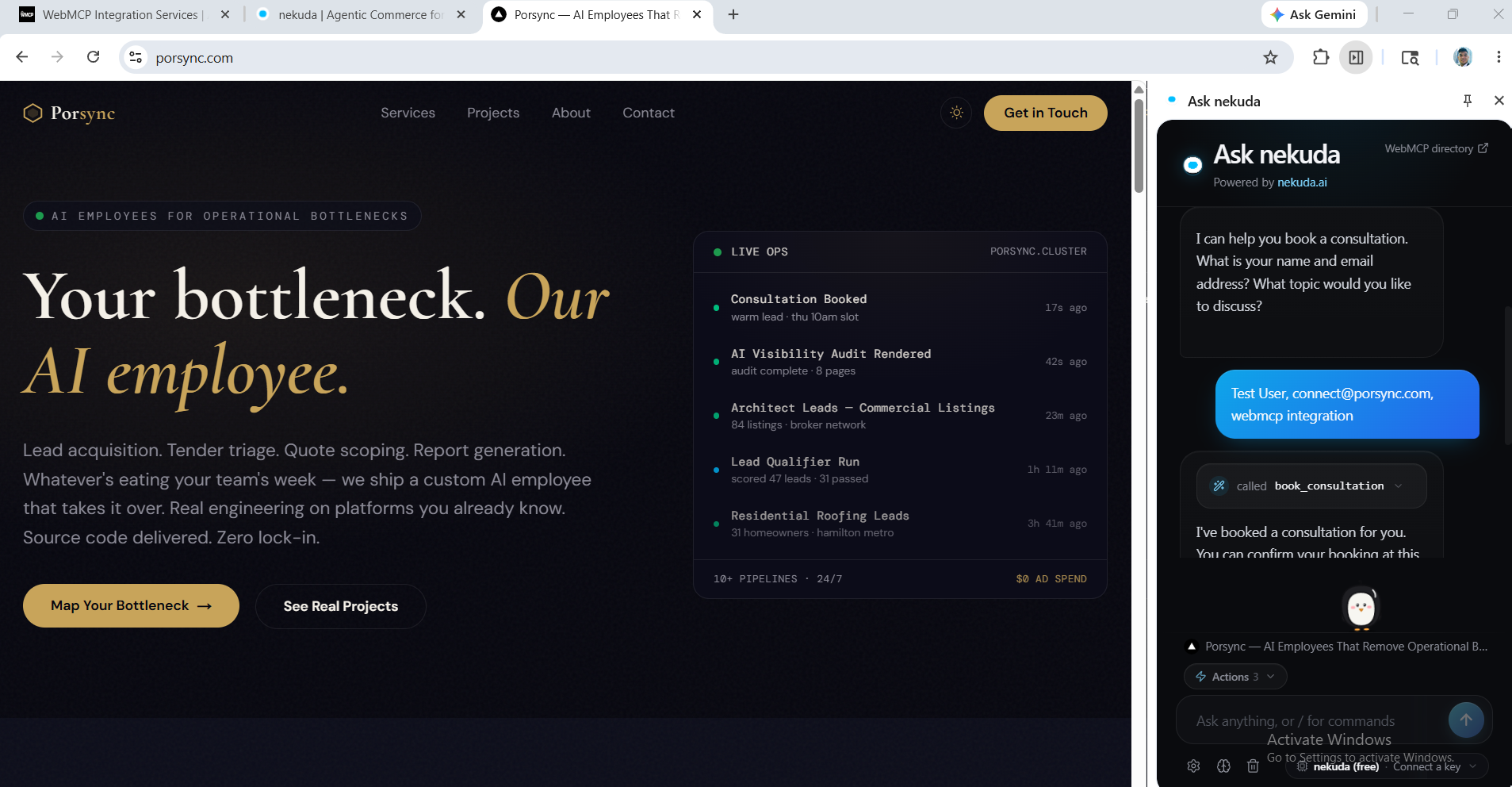
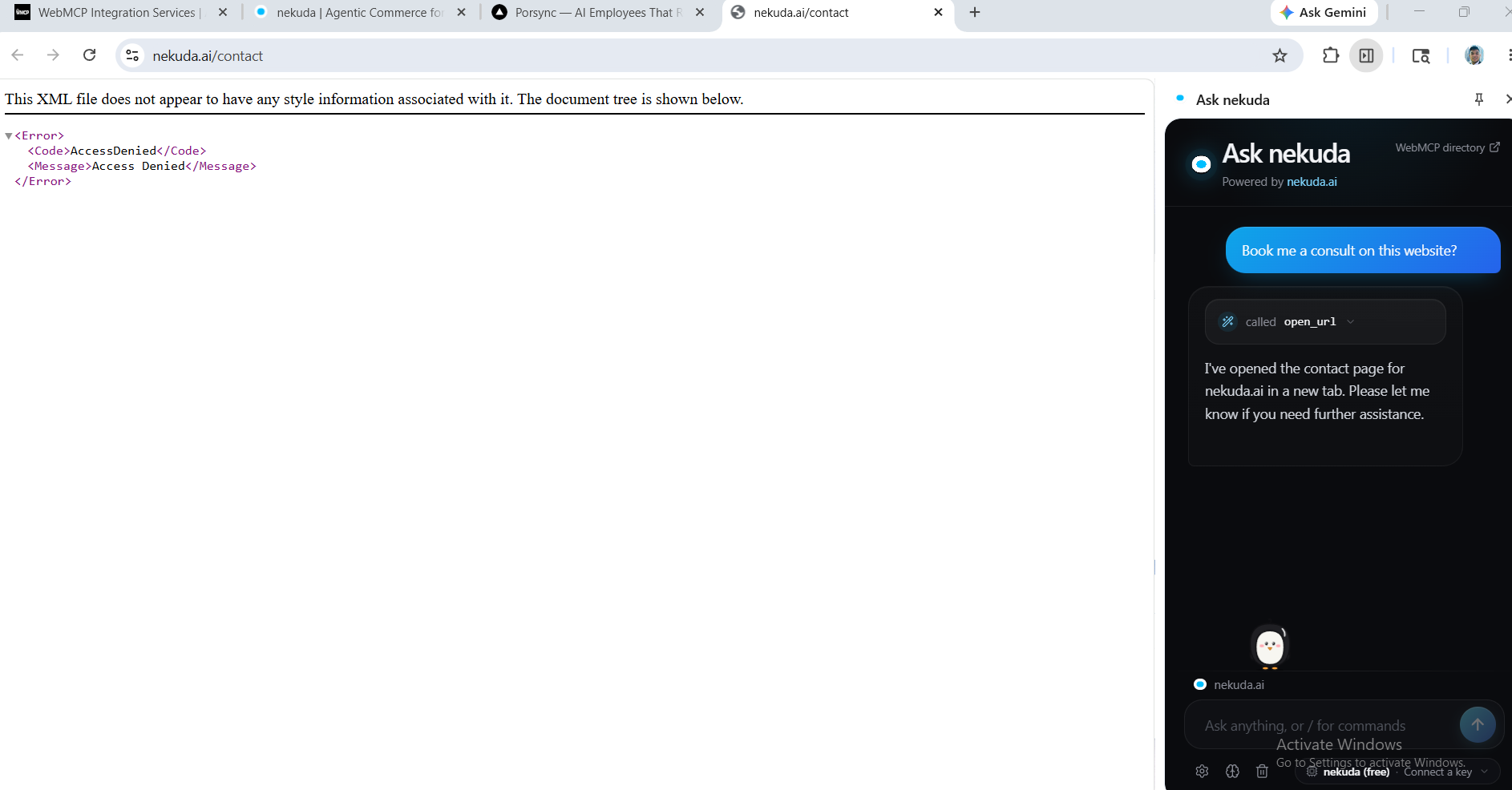
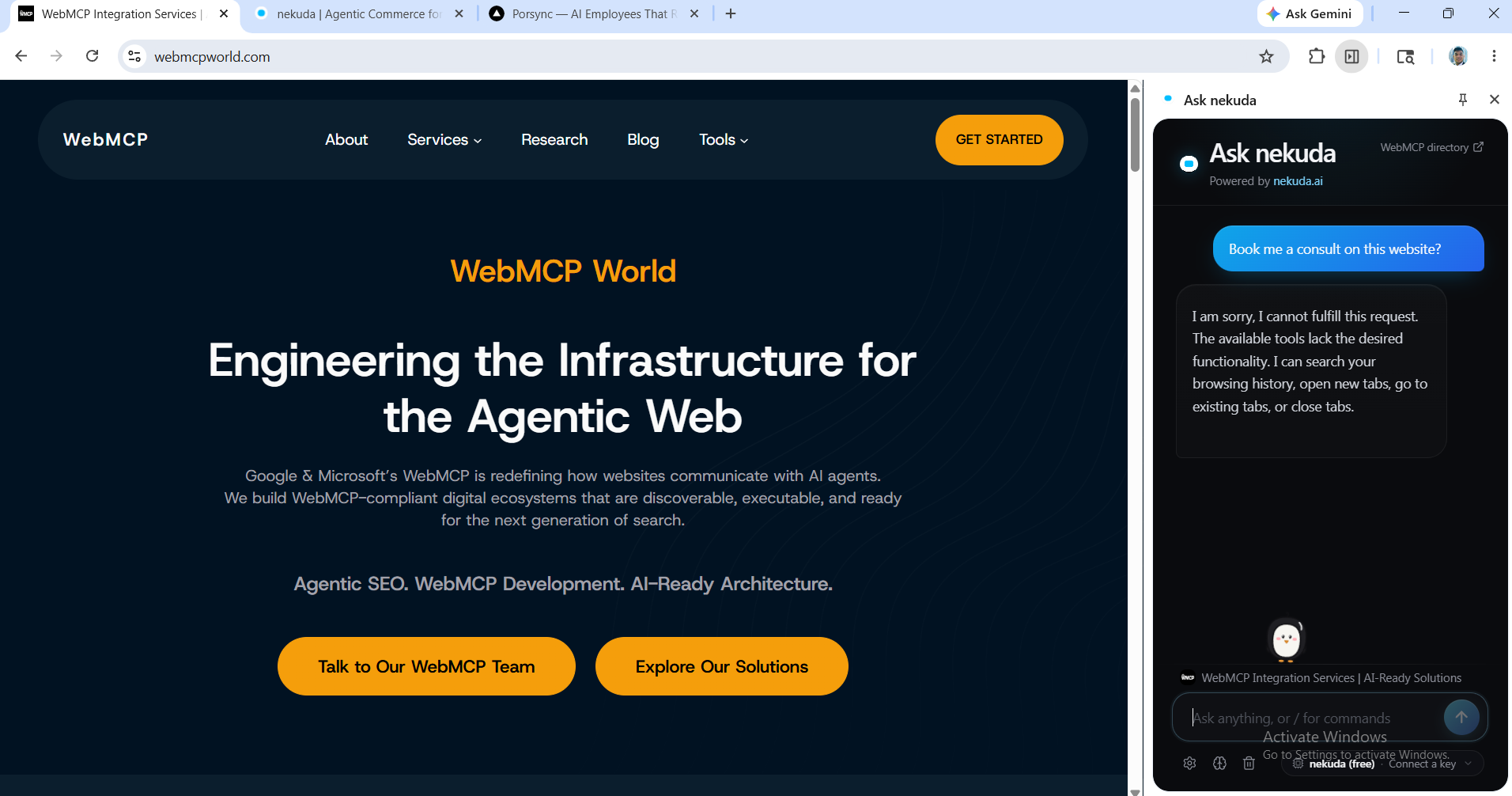
Why porsync.com worked and the others did not
The difference reduces to one thing: declarative WebMCP attributes. porsync.com tags `toolname`, `tooldescription`, and `toolaction` on its key CTAs. The other two sites have none. Without those attributes an agent has no structured signal about what actions exist or how to invoke them — so it guesses wrong or gives up.
It is worth being precise about the ceiling. Two of the 15 Inspector checks are not fully implementable today: imperative WebMCP (`navigator.modelContext`) is in the browser API but cross-browser integration is incomplete, and `window.ai` (Gemini Nano) is Chrome-only. porsync.com's 13/15 is therefore the maximum achievable score given current browser support. The two vendor sites are missing checks that *are* implementable today — not just the browser-dependent ones.
The finding, stated for citation
WebMCP readiness is a property of the site, not the widget. A well-instrumented site makes any compliant agent work. A poorly-instrumented site breaks even an agent purpose-built to work on it — including, in this benchmark, the vendor's own homepage.
Caveat and intent
Both vendors whose tools we tested are doing legitimate work in a genuinely new space; the spec is moving fast and most teams have not caught up. This is an architectural finding, not a quality judgment. The point is structural: if you want an AI agent to transact on your site, the work that matters is on *your* HTML, not in the agent.
porsync.com is the working reference implementation. Methodology and the live tool surface are documented at `/tools`.